The logistics and industrial sectors in Ghana are expanding rapidly. From the bustling ports of Tema to the manufacturing hubs in Kumasi, the demand for efficient material handling has never been higher. As businesses grow, the manual movement of goods becomes impossible to sustain. Efficiency is the currency of the modern warehouse, and the right equipment is how you earn it.
Selecting the correct machinery is the difference between a smooth operation and a logistical nightmare. For many business owners, the forklift is the heart of the warehouse. However, searching for warehouse equipment in Ghana can be overwhelming due to the sheer variety of options available. Buying a machine that is too small poses safety risks, while purchasing one that is too large burns fuel and money unnecessarily.
If you are currently looking for forklifts for sale in Ghana, this guide will help you navigate your options. We will specifically look at the robust solutions offered by Tractor Corner, focusing on the Massive CPCD range, to help you match the right tonnage to your specific business needs.
Assessing Your Warehouse Requirements
Before browsing catalogues or visiting dealerships, you must conduct an audit of your operational needs. A forklift is a significant investment, and the specific constraints of your facility dictate what you should buy.
Load Capacity and Centre
The most critical factor is the maximum weight you need to lift. If your average pallet weighs 2 tonnes, but you occasionally lift machinery weighing 4 tonnes, buying a 2.5-ton forklift will result in equipment failure or accidents. You must size your forklift for your heaviest load, not your average load.
Lift Height and Mast Type
How high is your racking system? Standard masts might reach 3 meters, but high-bay warehouses require triplex masts that can reach significantly higher. Ensure the forklift you choose can safely extend to your top shelf while retaining its lifting capacity.
Operating Environment
The Ghanaian climate and terrain play a major role in equipment longevity. Are you operating strictly indoors on smooth concrete, or is the forklift moving between a yard with uneven ground and a warehouse? Diesel forklifts, like the Massive range available at Tractor Corner, are often preferred in Ghana for their durability in dusty environments and their ability to handle rougher terrain compared to electric counterparts.
The Solution: The Massive Forklift Range
Tractor Corner Ghana has established itself as a reliable supplier of heavy-duty machinery tailored for the West African market. Their “Massive” series of forklifts (CPCD models) are diesel-powered workhorse designed to withstand rigorous daily use.
Here is a breakdown of the three primary models available and which business types they suit best.
The Agile Performer: Massive CPCD35 (3.5 Ton)
For many medium-sized warehouses and distribution centres, the Massive CPCD35 is the ideal entry point. With a lifting capacity of 3.5 tonnes (3,500 kg), this machine sits in the “sweet spot” of logistics. It is strong enough to handle heavy pallets of beverages, construction tiles, or automotive parts, yet compact enough to manoeuvre through standard warehouse aisles.
Who is this for?
- Retail Distributors: If you are moving consumer goods, foodstuffs, or electronics, the 3.5-ton capacity is more than sufficient.
- Manufacturing Plants: Perfect for moving raw materials to the production line and finished goods to the loading bay.
- Space-Constrained Facilities: This model offers a balance of power and size, making it easier to turn and reverse in tighter spaces than its larger counterparts.
The Heavy Lifter: Massive CPCD50 (5 Ton)
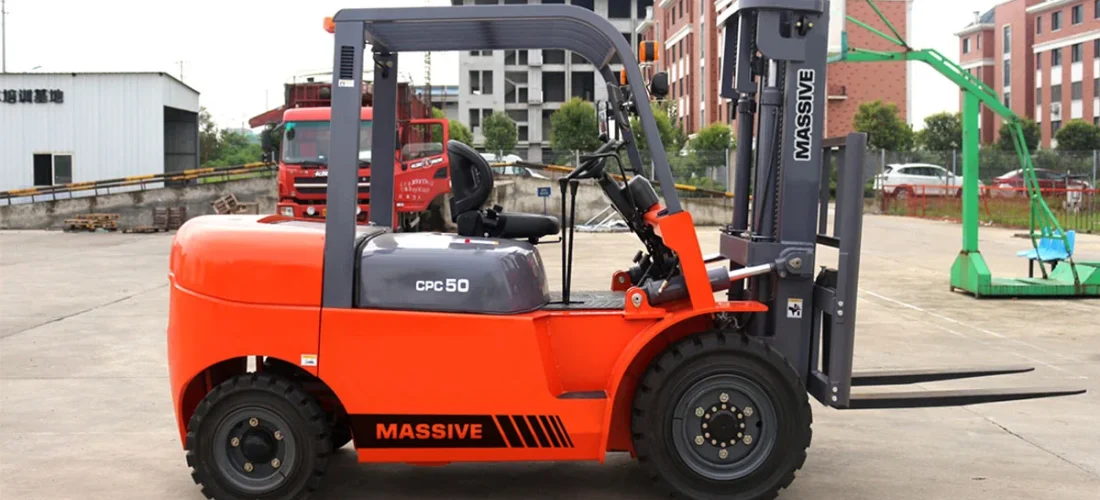
As we move up the weight class, the Massive CPCD50 enters the picture. A 5-ton forklift is a serious piece of warehouse equipment in Ghana, bridging the gap between standard logistics and heavy industry.
This machine provides greater stability when lifting wide or irregular loads. The chassis is heavier, acting as a better counterweight, which allows for safer operation when the mast is fully extended.
Who is this for?
- Construction Supply Yards: If you are lifting bundles of rebar, large sacks of cement, or heavy timber, the 3.5-ton model may struggle. The CPCD50 handles these dense materials with ease.
- Beverage Bottling Plants: Liquid is heavy. Pallets of bottled water or soft drinks stack up in weight quickly. The 5-ton capacity ensures you can move double pallets without tipping.
- Stone and Quarry Processing: For businesses dealing with cut stone or granite, the extra ruggedness of the CPCD50 is essential.
The Industrial Giant: Massive CPCD70 (7 Ton)
When your operations involve heavy industry, standard forklifts simply will not do. The Massive CPCD70 is designed for the toughest jobs in Ghana. With a lifting capacity of 7 tonnes, this machine is less about warehouse shelving and more about heavy cargo movement.
These machines are typically larger and require more turning space, so they are best suited for large open warehouses, outdoor yards, or ports.
Who is this for?
- Ports and Shipping: While not a reach stacker, a 7-ton forklift is capable of moving empty shipping containers or heavy cargo directly from trucks.
- Timber and Lumber Yards: Moving massive logs or large stacks of processed wood requires the high torque and hydraulic power that the CPCD70 provides.
- Steel and Iron Works: For moving coils of steel, iron pipes, or heavy machinery parts, this unit offers the necessary safety margins to prevent tipping.
Why Durability Matters in Ghana
When looking for forklifts for sale in Ghana, specifications are only half the story. The reliability of the machine is the other half. The operating conditions in Ghana can be harsh. High temperatures, humidity, and dust can wreak havoc on sensitive electronics found in some European or American-specific models.
The Massive range from Tractor Corner Ghana is built with simplicity and durability in mind.
- Diesel Reliability: Diesel engines provide high torque and can run for long shifts without the downtime of battery charging. In areas where the electricity supply might be inconsistent, diesel ensures your operation never stops.
- Maintenance: These machines are designed to be serviced easily. Parts availability is a crucial consideration; buying a rare brand often leads to machines sitting idle for weeks waiting for imported spares. Tractor Corner supports the Massive range, ensuring that your equipment remains operational.
- Cooling Systems: Effective cooling is vital in the tropical heat. The CPCD range is equipped with robust radiators to prevent overheating during heavy use.
Safety and Training
Regardless of which Massive model you choose—the 3.5, 5, or 7-ton—safety must remain a priority. Owning the equipment is the first step; using it correctly is the second.
Ensure your operators are trained specifically for the tonnage they are handling. A driver used to a small electric 1.5-ton forklift cannot simply jump into a Massive CPCD70 and operate it safely. The turning circles, braking distances, and blind spots are significantly different.
Furthermore, establish a daily check routine. In a warehouse environment, hydraulic hoses should be checked for leaks, tyres for wear, and fluid levels for consistency. Preventive maintenance is always cheaper than repairs.
Power Your Business Forward
Investment in quality capital equipment is one of the surest ways to increase the output of your business. Whether you are running a busy distribution centre in Accra or a timber yard in the Western Region, the speed at which you can load and unload trucks directly impacts your bottom line.
By understanding the differences between the Massive CPCD35, CPCD50, and CPCD70, you can make an informed choice that balances cost with capability. Do not underestimate your needs, but do not pay for capacity you will never use.
If you are ready to upgrade your operations, contact Tractor Corner Ghana to discuss these models in detail. Bringing the right warehouse equipment into your business in Ghana is the first step toward building a more efficient, profitable future.
Related Posts