

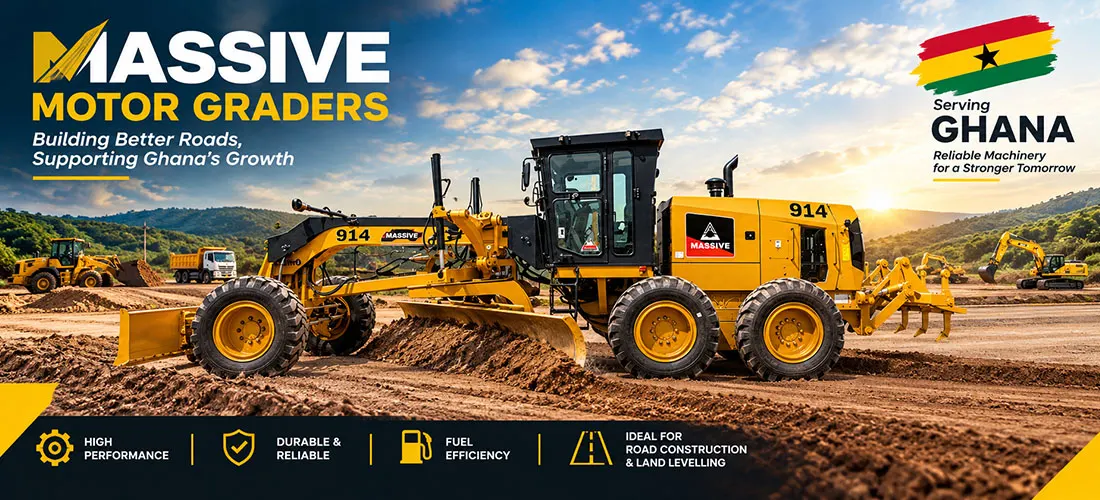
Choosing the right motor grader for a project in Ghana depends on the scale of your site, soil conditions, and the grading precision your project demands. Tractor Corner supplies MASSIVE motor graders for sale in Ghana, including the MASSIVE 913 and MASSIVE 914 models, giving contractors reliable heavy machinery in Ghana for road construction, land levelling, and infrastructure projects of varying sizes.
Road construction, mining, and land development projects across Ghana all share one requirement: a grading machine that can deliver a flat, even surface without wasting fuel or time. Pick the wrong motor grader, and you risk uneven roads, delayed project timelines, and costly repairs down the line. Pick the right one, and your crew finishes faster with fewer breakdowns.
This guide covers what matters when selecting a motor grader for work in Ghana, from blade control to engine power, and explains where models like the MASSIVE 913 and MASSIVE 914 fit for different project types. Whether you’re grading a rural access road or preparing a large commercial site, the goal is the same: match the machine to the job.
What factors determine the right motor grader for your project?
Motor graders aren’t one-size-fits-all. Before comparing specific models, contractors in Ghana should weigh a handful of core factors that influence performance on-site.
How big is your project site?
Smaller projects, such as residential road grading or short access tracks, don’t need the same horsepower or blade width as large-scale highway construction. Oversized equipment on a small site wastes fuel and adds unnecessary operating costs. Conversely, undersized machines on large sites slow down progress and increase wear from overexertion.
What type of soil and terrain will the grader work on?
Ghana’s terrain varies significantly by region — from the drier savannah in the north to the more humid, clay-heavy soils in the south. Clay and laterite soils common in many construction zones require strong blade down-pressure and stable articulation to maintain grading accuracy. Rockier or uneven terrain benefits from a grader with robust ground clearance and a durable undercarriage.
How precise does the finished grade need to be?
Projects like road base preparation or airport runways demand tighter tolerances than general land clearing. Machines with responsive hydraulic blade controls allow operators to make fine adjustments without stopping to recalibrate, which saves time on jobs where precision is non-negotiable.
What is your budget for upfront cost and long-term maintenance?
A motor grader is a long-term investment. Contractors should weigh purchase price against expected maintenance costs, parts availability in Ghana, and fuel efficiency over the machine’s working life. A slightly higher upfront cost can pay off quickly if it means fewer breakdowns and easier access to spare parts.
Why choose MASSIVE motor graders for sale in Ghana
Tractor Corner supplies motor graders from MASSIVE, a brand built for durability and consistent performance across demanding construction environments. Two models commonly available through Tractor Corner — the MASSIVE 913 and MASSIVE 914 — serve different project needs within the same product line, making it easier for contractors to find heavy machinery in Ghana that matches their specific job requirements without switching suppliers.
What makes the MASSIVE 913 motor grader a strong option?
The MASSIVE 913 is suited to contractors who need dependable grading performance for everyday construction and road maintenance work. For teams managing recurring grading tasks, having a machine that performs predictably shift after shift reduces downtime and keeps project schedules on track.
What makes the MASSIVE 914 motor grader different?
The MASSIVE 914 is positioned as a step up within the MASSIVE lineup, built for contractors tackling larger or more demanding grading projects. Choose the MASSIVE 914 if your site size, soil conditions, or project timeline call for a machine with greater grading capacity than the 913 offers.
Because both models come from the same manufacturer, parts compatibility and operator training transfer more easily between the two. This is a practical advantage for Ghanaian contractors running mixed fleets or scaling up equipment as project demand grows.
How do you match a motor grader to your specific project type?
Matching the right grader to the job isn’t about picking the biggest or newest machine. It’s about aligning the equipment’s strengths with your project’s demands.
- Road construction and maintenance: Choose a grader with reliable blade control and a design suited for repetitive grading passes, such as the MASSIVE 913, if your work involves regular road upkeep rather than large-scale new construction.
- Large-scale infrastructure or commercial development: Choose a grader with greater grading capacity, such as the MASSIVE 914, if your project involves extensive site preparation across large or uneven plots.
- Mixed-terrain or variable soil conditions: Prioritise a machine with strong hydraulic responsiveness, which helps operators adjust grading depth quickly as soil conditions shift across the site.
- Budget-conscious projects with moderate scale: Weigh the total cost of ownership, not just the purchase price. A well-maintained motor grader with accessible parts in Ghana often proves more economical over time than a cheaper machine with limited local support.
What should you check before buying heavy machinery in Ghana?
Before finalising any motor grader purchase, confirm a few practical details with your supplier:
- After-sales support — Ask whether the supplier, such as Tractor Corner, offers maintenance support and access to genuine replacement parts within Ghana.
- Operator training — Check if training is available for your team, particularly if you’re new to the MASSIVE brand or upgrading from a different manufacturer.
- Warranty terms — Understand what’s covered and for how long, especially for major components like the engine and hydraulic system.
- Delivery and logistics — Confirm realistic delivery timelines so the equipment arrives when your project schedule requires it.
Taking the time to verify these details upfront prevents costly surprises once the machine is already on-site.
Get your project moving with the right equipment
Selecting a motor grader comes down to understanding your project’s scale, soil conditions, and precision requirements, then matching that profile to a machine built for the job. Tractor Corner’s range of MASSIVE motor graders for sale in Ghana, including the MASSIVE 913 and MASSIVE 914, gives contractors options across different project sizes without compromising on reliability.
If you’re planning a road construction, land development, or infrastructure project in Ghana, reach out to Tractor Corner to discuss which MASSIVE model fits your site requirements and budget.
Frequently asked questions
What is the difference between the MASSIVE 913 and MASSIVE 914 motor graders?
The MASSIVE 913 suits everyday grading and road maintenance work, while the MASSIVE 914 is built for larger or more demanding grading projects. The right choice depends on your project’s scale and soil conditions.
How much does a motor grader cost in Ghana?
Pricing for motor graders in Ghana varies based on the model, condition, and supplier. Contact Tractor Corner Ghana directly for current pricing on the MASSIVE 913 and MASSIVE 914.
Who should consider buying a motor grader instead of renting one?
Contractors with ongoing or recurring grading needs, such as road maintenance companies or large construction firms, generally benefit more from purchasing, since frequent rental costs can exceed the cost of ownership over time.
What maintenance does a MASSIVE motor grader require?
Like all heavy machinery, motor graders require regular checks on hydraulic systems, blade wear, and engine servicing. Confirm maintenance schedules and parts availability with your supplier at the time of purchase.
Are MASSIVE motor graders suitable for Ghana’s terrain?
MASSIVE motor graders, including the 913 and 914 models, are designed to handle the varied soil and terrain conditions found across different regions of Ghana, from road construction sites to land development projects.
Related Posts
