The industrial landscape across Africa is shifting rapidly, and nowhere is this more evident than in Nigeria. As the continent’s largest economy, the demand for efficient movement of goods has never been higher. From the bustling ports of Lagos to the manufacturing hubs in Ogun and the expanding distribution networks in Abuja, the pressure is on to move materials faster and safer.
Manual handling, once the backbone of Nigerian warehousing, is struggling to keep pace with modern demands. Supply chains are becoming more complex, and consumer expectations for rapid delivery are rising. This is where mechanisation steps in. The adoption of heavy-duty material handling equipment is no longer a luxury for large multinationals; it has become a necessity for businesses of all sizes looking to scale.
At the heart of this operational shift is the humble forklift. These powerful machines are transforming how warehouses operate, turning chaotic storage spaces into streamlined hubs of productivity. By reducing the reliance on manual labour for heavy lifting, businesses are seeing drastic improvements in turnaround times and worker safety.
The Shift from Manual Labour to Mechanisation
For decades, many Nigerian businesses relied heavily on human capital to load, unload, and stack goods. While labour is abundant, manual handling comes with significant limitations. It is time-consuming, prone to human error, and carries a high risk of injury. In a market where speed equates to profitability, these limitations can become major bottlenecks.
The introduction of robust machinery for sale in Nigeria has significantly altered the landscape. Forklifts allow a single operator to do the work of ten men in a fraction of the time. This efficiency allows businesses to maximise their storage space by stacking goods vertically—something impossible to do safely by hand. This vertical utilisation of warehouse space effectively doubles or triples storage capacity without the need for acquiring expensive new real estate.
Furthermore, the consistency provided by machinery reduces product damage. Goods are moved with precision, reducing the losses associated with dropped crates or mishandled stock. For sectors like agriculture, construction, and retail, this reliability is invaluable.
Choosing the Right Equipment for the Job
Not all warehouses are created equal, and neither are the machines that power them. Selecting the right forklift depends entirely on the nature of the goods being moved and the environment they are moving in. Factors such as load weight, lifting height, and turning radius all play a critical role in the decision-making process.
Suppliers like Tractor Corner have recognised the diverse needs of the Nigerian market. They offer a range of forklifts for sale in Nigeria, designed to tackle everything from light commercial goods to heavy industrial materials. Their “Massive” range of forklifts has gained traction for delivering the durability required to withstand rigorous daily use.
The Massive CPCD35 3.5 Ton Forklift
For many mid-sized logistics centres and manufacturing plants, the Massive CPCD35 is the ideal workhorse. With a lifting capacity of 3.5 tons, it sits in the “sweet spot” of material handling. It is agile enough to navigate standard warehouse aisles yet powerful enough to handle substantial pallets of goods, construction materials, or agricultural produce.
The 3.5-ton capacity makes it particularly versatile. It can easily handle the loading and unloading of shipping containers, a critical task for businesses involved in import and export. Its robust engine is designed to perform reliably in Nigeria’s climate, ensuring that operations don’t grind to a halt due to overheating or mechanical failure during peak shifts.
The Massive CPCD50 5 Ton Forklift
When operations demand more power, the Massive CPCD50 steps up. A 5-ton lifting capacity moves this machine into the heavy-duty category. This model is frequently seen in larger distribution centres, timber yards, and construction sites where loads are dense and bulky.
The advantage of the 5-ton model lies in its stability. Heavier loads require a machine with a lower centre of gravity and a robust chassis to prevent tipping. The CPCD50 offers the assurance that heavy machinery parts, large stacks of cement, or steel beams can be transported safely across uneven terrain. For businesses looking for machinery for sale in Nigeria that bridges the gap between warehousing and outdoor industrial work, this model offers a compelling solution.
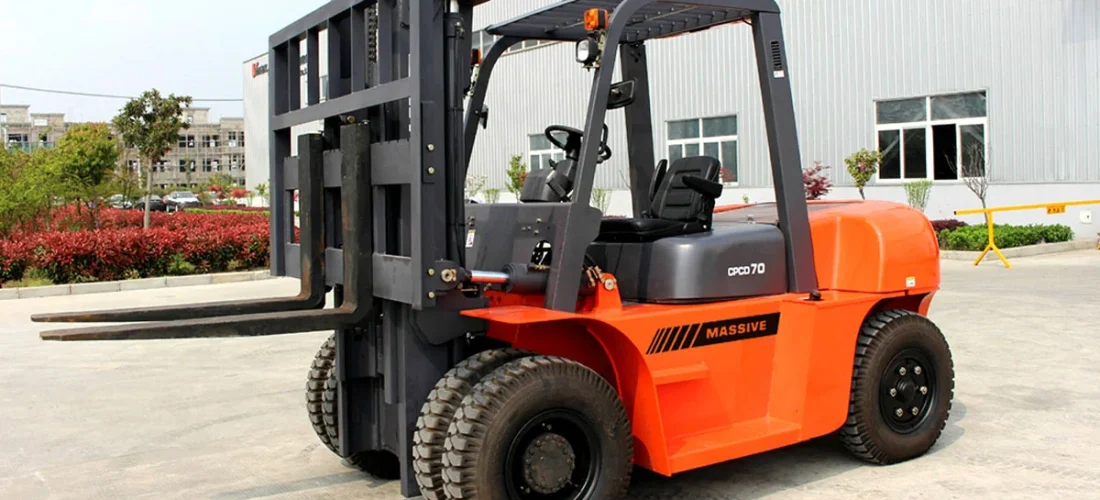
The Massive CPCD70 7 Ton Forklift
At the top end of the standard commercial range sits the Massive CPCD70. With a formidable 7-ton lifting capacity, this machine is built for the most demanding environments. You will often find these giants in ports, steelworks, and large-scale manufacturing plants.
Handling seven tons requires immense hydraulic power and structural integrity. The CPCD70 is engineered to endure high-stress cycles, lifting heavy containers and massive industrial components with ease. Investing in a machine of this calibre is a strategic move for heavy industry players in Nigeria. It ensures that no load is too heavy, preventing production delays that occur when equipment is underpowered for the task at hand.
The Economic Impact on Nigerian Businesses
Investing in quality material handling equipment has a direct correlation with the bottom line. While the upfront cost of purchasing a forklift is significant, the return on investment becomes clear quickly.
Faster loading times mean delivery trucks spend less time waiting at the dock and more time on the road. This improved turnaround can allow a logistics company to squeeze in an extra delivery run per day, directly increasing revenue. Similarly, in a manufacturing setting, raw materials can be fed into production lines without delay, keeping factory output at maximum capacity.
Moreover, safety is a financial factor. Workplace accidents involving heavy lifting can result in significant medical expenses, legal complications, and prolonged downtime. By mechanising these tasks, businesses significantly lower their liability and create a safer environment for their workforce.
Frequently Asked Questions
Where is the best place to find forklifts for sale in Nigeria?
There are several reputable dealers, but it is essential to look for suppliers who offer after-sales support and spare parts. Tractor Corner Nigeria is a notable provider, offering a range of “Massive” brand forklifts known for their suitability for the Nigerian market.
Should I choose a diesel or an electric forklift?
This depends on your usage. Diesel forklifts (like the CPCD series) are generally preferred for outdoor use and heavy lifting because they provide more torque and don’t require downtime for charging. They are excellent for the rugged conditions often found in Nigerian industrial zones. Electric forklifts are better suited for indoor, enclosed environments where ventilation is a concern, such as food storage warehouses.
Is it difficult to maintain heavy machinery in Nigeria?
Maintenance is key to longevity. While parts availability used to be a challenge, the supply chain for machinery for sale in Nigeria has improved. Choosing a popular model like the Massive series ensures that spare parts and knowledgeable mechanics are more readily available compared to obscure brands.
What is the lifespan of a Massive forklift?
With proper maintenance, including regular oil changes and hydraulic checks, a robust diesel forklift can last for over a decade of daily service. The lifespan is heavily dictated by how well the machine is serviced and whether it is operated within its weight limits.
Powering Future Growth
The trajectory of Nigeria’s economy points toward continued industrialisation and an expanding logistics sector. As the volume of trade increases, the manual methods of the past will become increasingly obsolete. The businesses that will thrive are those that recognise the value of efficiency and invest in the right tools to achieve it.
Adopting advanced material handling solutions like the Massive CPCD35, CPCD50, and CPCD70 is about more than just buying a vehicle; it is about future-proofing operations. Whether moving pallets in a Lagos warehouse or transporting heavy timber in a rural depot, the right forklift serves as the engine of growth.
For business owners and fleet managers exploring forklifts for sale in Nigeria, the options have never been better. Companies like Tractor Corner Nigeria are bridging the gap, bringing world-class machinery to local industries and ensuring that Nigeria keeps moving forward, one pallet at a time.
Related Posts